Loading…
Same or next day
Villa Gates, Motors and Access Automation
A villa gate is the system whose failure you notice immediately, usually while sitting in the car. Most faults fall into three groups: the motor and its drive, the control side including remotes and receivers, and the safety sensors that stop the gate if they think something is in the way. The third group causes more callouts than people expect, because photocell sensors sit low, face outward, and get knocked, dusted over and sun-blinded — and a sensor that thinks it is obstructed will stop the gate dead with nothing actually wrong. Working out which of the three groups you are in takes a few minutes and determines everything that follows.
01WHAT WE GET CALLED FOR
Ordered roughly by how often we see them. The “tell” is the observation that separates each one from the others.
Gate starts, moves partway, then stops or reverses
Consistent stopping point suggests an obstruction or limit setting; a random one suggests the drive or power.
Remote works close up but not from the driveway
Range has shrunk. Battery or receiver aerial rather than the motor.
Gate refuses to close but opens normally
Classic safety sensor signature — the closing direction is the protected one.
Motor hums but the gate does not move
Power reaching the motor but no drive. Capacitor, gearbox or a released clutch.
Sliding gate juddering along its run
Track debris, a worn roller, or gate alignment rather than a motor fault.
Everything dead after a power interruption
Control board reset or a tripped supply. Check the manual release first so you are not stuck.
02WHAT’S DIFFERENT IN A VILLA
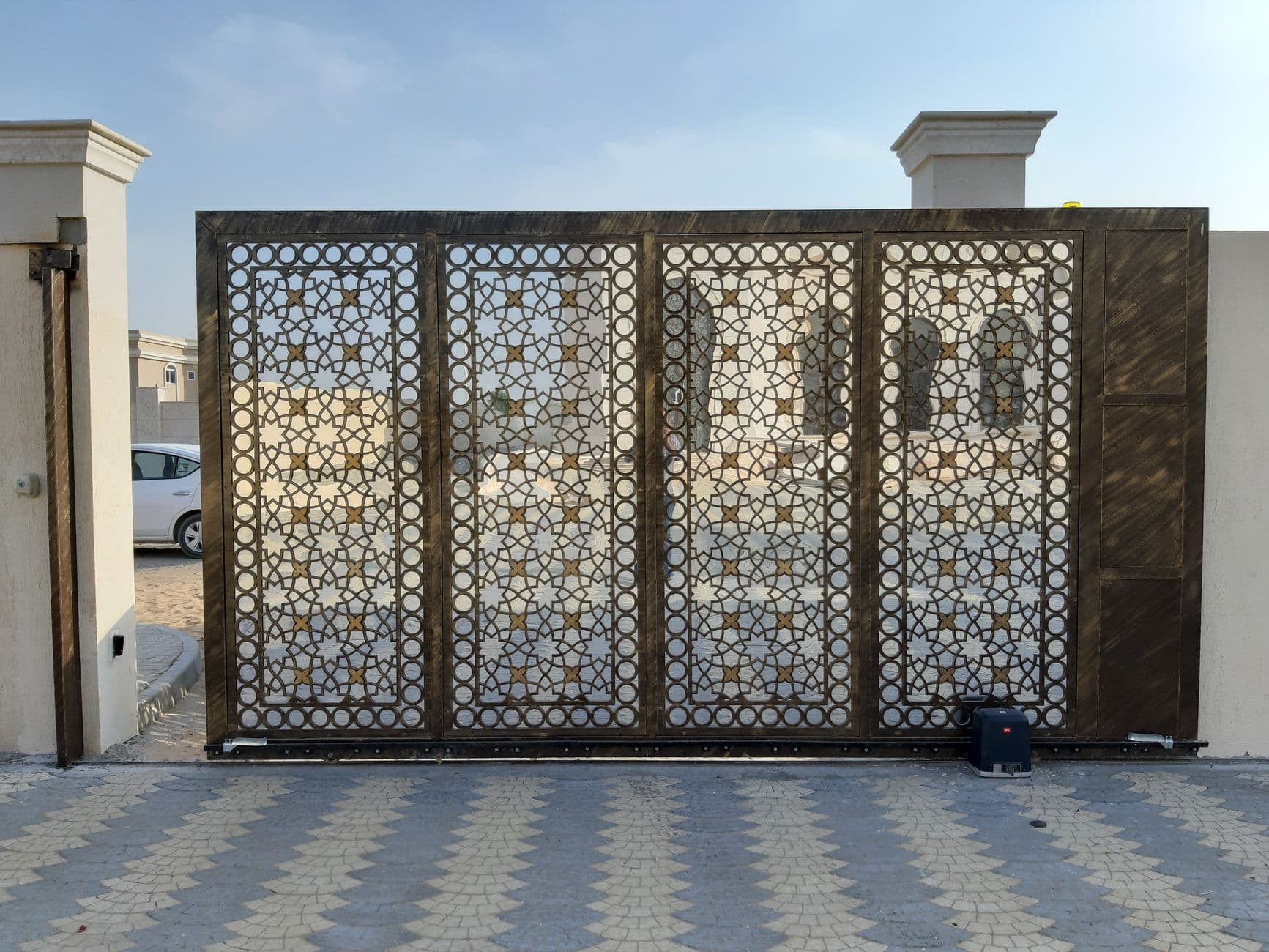
Dust is what actually kills villa gate automation in Dubai, and it works on the two most vulnerable parts at once. Sliding gate tracks collect grit that packs down until the rollers start fighting it, which puts load on the motor that it was never sized for and eventually takes out the gearbox or the capacitor. At the same time the photocell sensors, mounted low on either side of the opening, film over with the same dust until they no longer see each other reliably — and an unreliable sensor pair produces exactly the intermittent, maddening "it works sometimes" fault that gets misdiagnosed as a failing motor. Clearing the track and cleaning the sensor faces resolves a meaningful share of gate callouts entirely.
03ON SITE
How we work through it.
Confirm manual release works
Before anything else, we make sure you can open the gate by hand. You should never be trapped in or out while a repair is arranged.
Separate control from drive
Does the motor receive the command and fail to act, or never receive it? That single test splits the fault into two very different repairs.
Check the safety circuit
Photocell alignment, cleanliness and continuity. Sensors cause a large share of gate faults and they are cheap to rule out.
Inspect the mechanics
Track, rollers, hinges and alignment. A motor struggling against a mechanical problem will keep failing until the mechanics are corrected.
Set limits and test repeatedly
Travel limits and force settings are reset and the gate cycled several times, because intermittent faults do not show on a single run.
04Typical villa gate callout
AED 200 – 1,100 depending on the fault
Sensor alignment, remote programming and track clearing sit at the lower end. Capacitors, control boards and gearbox work sit higher. Full motor replacement is quoted separately after inspection.
05QUESTIONS WE GET ASKED
- The gate opens but will not close. What causes that?
- Almost always the safety sensors. Closing is the protected direction, so if the photocells think something is in the opening the gate will refuse to close while still opening perfectly normally. Dust on the lenses, a knock that has shifted alignment, or strong low sun are the usual causes and all are quick to correct.
- My remote only works right next to the gate.
- Shrinking range points at the remote battery or the receiver aerial rather than the motor. Both are inexpensive. If a new battery does not restore the range, the aerial positioning or the receiver itself is the next thing to check.
- Can I still get out if the motor has failed?
- Yes — every automated gate has a manual release, usually a key-operated lever on the motor housing. If you do not know where yours is or how it works, ask us to show you on the visit. It takes two minutes and it means a future failure is an inconvenience rather than an emergency.
- The gate judders along its track. Is the motor going?
- More often it is the track. Grit packs into the run and the rollers start fighting it, which the motor then has to overcome. Left alone that extra load does eventually damage the drive, so clearing the track early is genuinely preventative rather than cosmetic.
06TELL US WHAT IT IS DOING
Describe what your villa is doing.
The more detail you give us — which rooms, when it started, what you’ve already tried — the better prepared we arrive.