Loading…
Emergency response
Air Conditioning — Diagnosis and Repair
A villa doesn't fail the way a flat does. You've usually got four to nine indoor units feeding off two or three condensers, long refrigerant runs to a roof or a side yard, and a zone or two nobody has looked at since handover. That changes the diagnosis completely. When one bedroom goes warm and the rest of the house is fine, the fault is almost never the condenser — it's a zone valve, a blocked filter, or a thermostat that has quietly lost its calibration. When the whole ground floor drops off at the same time, that's a shared circuit or a condenser that's tripping on high head pressure. We start by working out which of those two stories we're in, because they lead to completely different work and completely different bills.
01WHAT WE GET CALLED FOR
Ordered roughly by how often we see them. The “tell” is the observation that separates each one from the others.
Cools for fifteen or twenty minutes, then blows warm
The outdoor fan is still spinning but the compressor has gone quiet — usually a thermal cut-out on high head pressure.
One room warm, the rest of the villa fine
Supply air at that grille is close to room temperature while other grilles are cold. Points at the zone, not the plant.
Water staining a ceiling below an indoor unit
Stain spreads outward from a single point directly under the unit — a condensate tray or drain line, not a roof leak.
Loud rattle that starts a few seconds after the unit does
Timing matters. A rattle on start-up is usually a fan or a loose panel; a constant hum is more often the compressor.
Whole villa trips the board when the AC kicks in
Everything else in the house works until the compressor starts. That is an electrical fault presenting as an AC fault.
Cooling is weak everywhere and bills have climbed
No single failure — usually refrigerant loss across a long run, or condensers that have not been cleaned since installation.
02WHAT’S DIFFERENT IN A VILLA
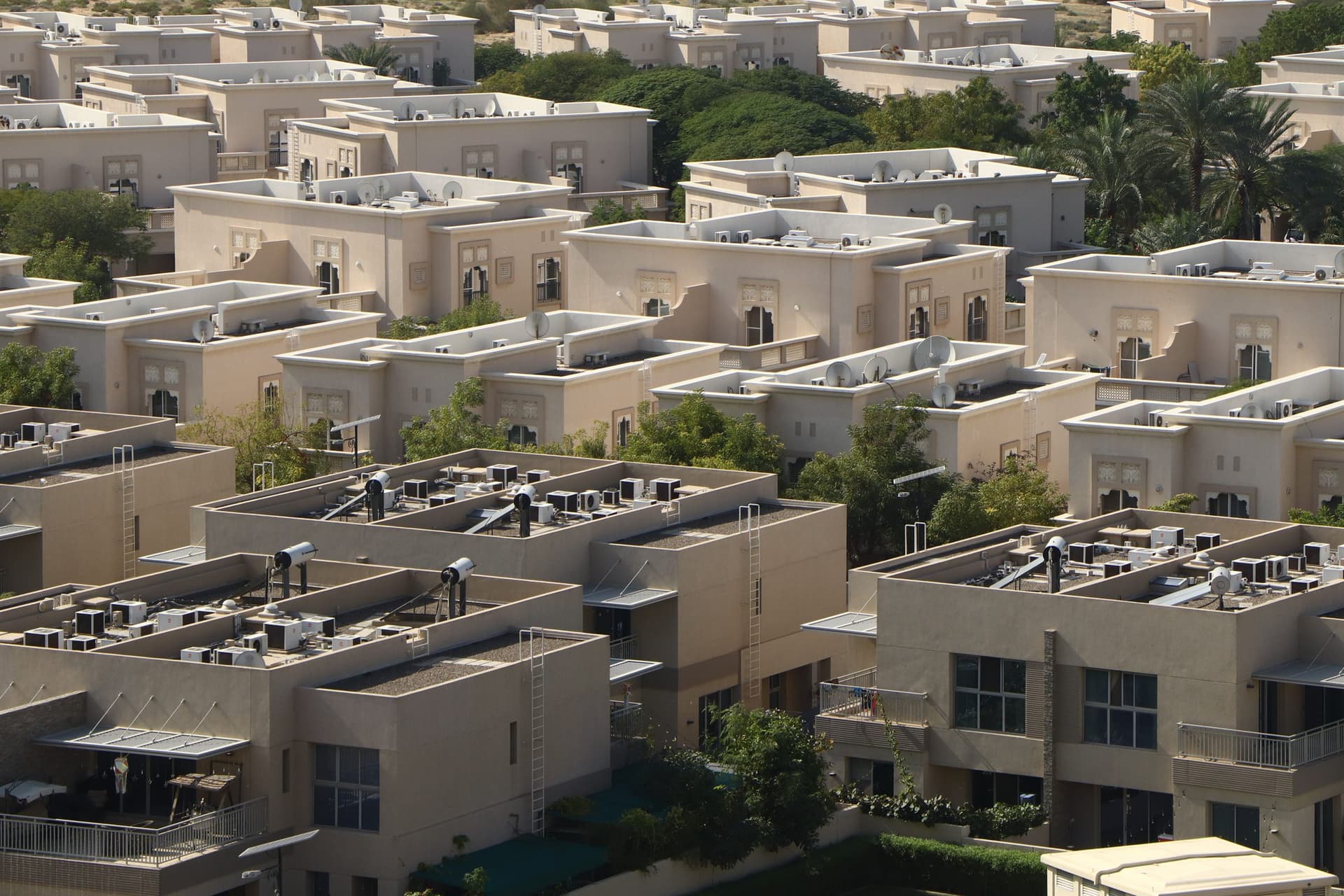
Roof-mounted condensers are the thing that catches villa owners out. They sit in full sun on a flat roof, nobody sees them, and by year three the coil fins are packed with dust from the surrounding plots. A condenser that can't reject heat runs hot, and a compressor that runs hot cuts out on the thermal — which the homeowner experiences as "it cools for a while and then stops". Half the callouts we take for that symptom are resolved by cleaning coils properly and checking the fan, not by adding gas. The longer refrigerant runs in a villa also mean a slow leak shows up as gradually worse cooling across months rather than a sudden failure, so it tends to get tolerated far longer than it should.
03ON SITE
How we work through it.
Establish the pattern
Which units, which rooms, at what time of day, and whether it changed suddenly or drifted. This decides whether we start at the plant or in the room.
Measure before touching
Supply and return air temperatures at the affected grilles, then pressures at the condenser. Numbers first — we do not open a system on a hunch.
Inspect the condenser
Coil condition, fan operation, clearances, and electrical connections. On roof installations this is where a large share of villa faults actually live.
Report before repair
You get told what we found, what it costs, and what happens if it is left. Work starts after you agree, not before.
Verify under load
We run the system through a full cycle and re-measure at the same grilles, so the fix is demonstrated rather than asserted.
04Typical villa AC callout
AED 180 – 900 depending on the fault
Diagnostic visit and measurement are quoted up front. Coil cleaning, fan motors and control faults sit at the lower end; compressor and refrigerant work at the upper. Anything involving parts is priced after inspection, never before.
05QUESTIONS WE GET ASKED
- The unit cools then stops. Is that low gas?
- Often it is not. That specific pattern — cooling normally and then losing the compressor while the outdoor fan keeps running — points more often at a thermal cut-out from a condenser that cannot shed heat. Coil condition and fan operation get checked before anyone talks about refrigerant. Topping up a system that is not short of gas wastes your money and hides the real fault.
- Do I need every unit serviced, or just the one that failed?
- Just the one that failed, if the rest are genuinely fine. We will tell you honestly if the others show early signs, but there is no automatic upsell to a whole-villa service. If several units share a condenser, we do check that condenser regardless, because a fault there affects all of them.
- There is a stain on the ceiling under an indoor unit. Is that the AC or the roof?
- Look at the shape. Condensate problems spread outward from a single point directly beneath the unit and get worse when the AC runs hardest. Roof ingress usually appears away from the unit and tracks along a beam or a wall line. We confirm by running the unit and watching whether the stain darkens.
- How long does a villa AC diagnosis take?
- Usually forty-five minutes to an hour and a half for a multi-unit villa, because measuring at several grilles and getting onto the roof takes real time. We would rather spend the extra half hour measuring than guess and come back twice.
06TELL US WHAT IT IS DOING
Describe what your villa is doing.
The more detail you give us — which rooms, when it started, what you’ve already tried — the better prepared we arrive.